Innovation propels the aerospace industry forward, and Alpha Metalcraft Group is in the embryonic stages of developing a process that could save time and money for manufacturers in the rapidly burgeoning electric vertical take-off and landing (eVTOL) market.
AMG manufactures nickel abrasion guards, which protect carbon fiber-filled composite rotary blades from erosion, impact damage, and surface wear caused by debris, rain and friction. Abrasion guards, also called leading edge guards, extend the service life of the part and are installed on blades for helicopters, eVTOLs and other rotary aircraft.
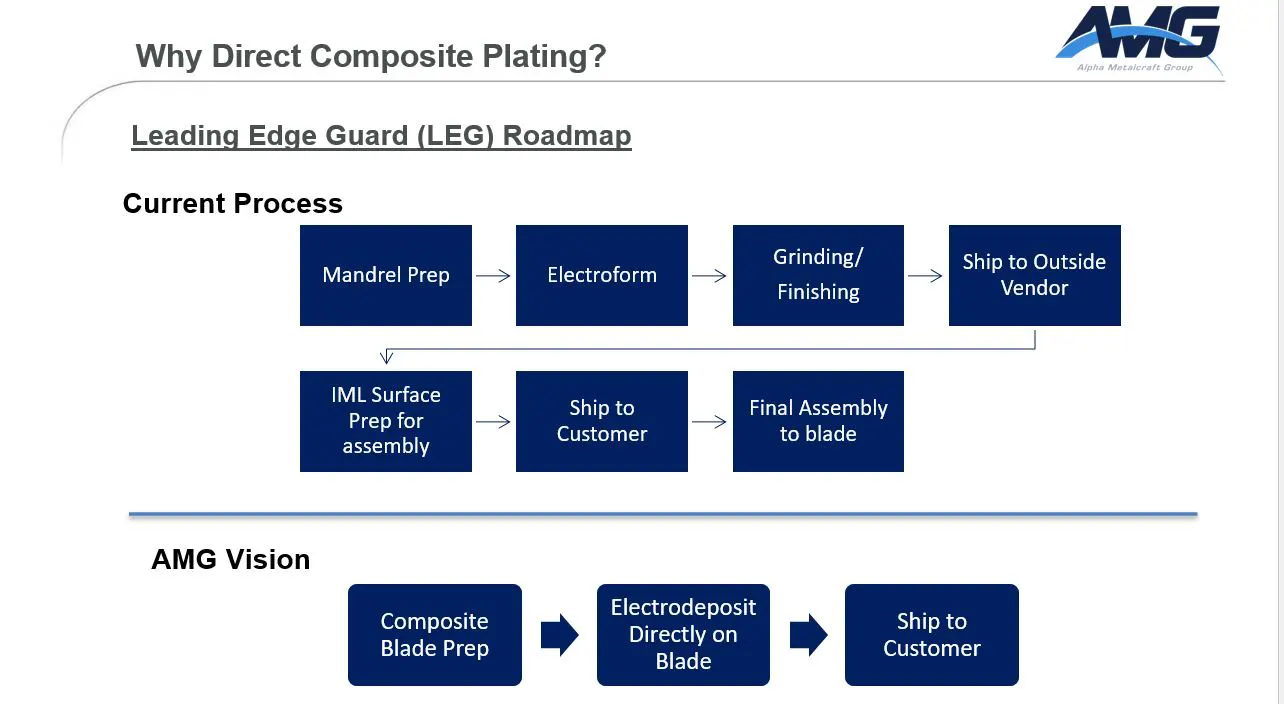
The guards are manufactured via electroforming, one of AMG’s core processes, and are attached to rotary blades in several steps. The guards must meet strict design specifications and are then shipped between multiple locations for surface treatment, bonding and final assembly.
AMG is working in cooperation with aerospace suppliers in designing an electroplating-ready composite blade that would allow for direct nickel deposition, provide excellent adhesion and significantly reduce the time and cost to manufacture ready-to-assembly propeller blade designs.
“The ability to directly plate a nickel substrate onto a carbon filled composite structure eliminates the need for multiple assembly processes and can lower overall manufacturing costs,’’ said Director of Engineering for AMG Luigi Cazzaniga. “It will still ensure proper adhesion of the nickel abrasion guard to the composite surface.”
Aerospace manufacturers have expressed interest, but there are challenges that need to be solved. “We are finding that every blade is unique,’’ Cazzaniga said. “Every manufacturer makes blades their own way. For every manufacturer, we have to determine what composite do they use, and what epoxy system do they use. I think we’ve piqued their interest, and the next stage is to generate this into a development program, and it needs to be a partnership.”
Adhering leading edge guards to composite blades is one of the primary difficulties. The current process requires a bonding pretreatment step, followed by a process referred to as Sol-Gel, which was commercialized for aerospace applications in the late 1990s. In this process, a highly durable chemical bond between metallic substrates and paints, primers or adhesives acts as an interface layer that enhances corrosion resistance and prevents adhesive failures. The process is normally accomplished by third-party vendors, after which the metal guard is returned to the customer, where additional labor time is required to bond and assemble the final two parts into a complete unit.
“All of these processes add potential cost associated with potential handling damage and multiple inspection steps as the parts move through the value chain,’’ Cazzaniga said.
One other industry concern is repairability, especially for the defense market. Blades for the eVTOL market are smaller and less expensive to fabricate. “Each motor normally calls for five blades or more, and each aircraft is now being designed with up to eight electric motors,’’ Cazzaniga says. “With several hundred aircraft built every year, the number of blades quickly adds up, as do the associated manufacturing and assembly costs.”
There is still a lot of work to do, but what’s clear is demand is going to escalate. Economists predict the market will reach $18.92 billion in 2026, with a compound annual growth rate of 31.7 percent. All of those aircraft will need rotary blades with leading edge guards.
“This is a project that’s going to require a level of collaboration,’’ Cazzaniga said. “I think we’ve done our part, and we’re still doing it. We need to partner with a composite manufacturer. There are aspects, such as rotation effects and FAA certification, that require their expertise. But as with any innovation, you look at the big picture first, and then some of the details pop out. Some are beneficial, some are roadblocks. We can work through those, and we’re hopeful we can develop a process that works for everyone.”